MNQ vs NQ: Which Nasdaq Futures Contract to Learn On
MNQ vs NQ: both follow the Nasdaq-100, and MNQ is one tenth the size. Point and tick values, margin, fees, and which one to learn on.

If you're learning to trade Nasdaq futures, you'll run into two tickers almost right away: NQ and MNQ. They follow the same index and move on the same chart. The difference is size, and size decides how many dollars change hands when the chart moves.
What NQ and MNQ are
A futures contract is an agreement to buy or sell something at a set price on a later date. With index futures nothing gets delivered. The contract is settled in cash, so what you're really trading is the price moves.
Both of these contracts follow the Nasdaq-100, an index of 100 of the largest non-financial companies listed on Nasdaq. Both trade on CME Group's exchange.
- NQ is the E-mini Nasdaq-100. One contract is worth $20 times the index.
- MNQ is the Micro E-mini Nasdaq-100. One contract is worth $2 times the index.
So MNQ is one tenth the size of NQ.
The math in plain words
A point is one full point of the index. A tick is the smallest move the price can make, and on both contracts it's a quarter of a point (0.25).
| NQ | MNQ | |
|---|---|---|
| Dollars per point | $20 | $2 |
| Dollars per tick (0.25 points) | $5.00 | $0.50 |
| Contracts to equal one NQ | 1 | 10 |
So is 5 MNQ equal to 1 NQ? Nope. It takes 10.
What stays the same
The chart, the hours and the setups. Because both contracts follow the same index, a setup on one shows up at the same moment on the other. They trade the same hours on CME: Sunday 6:00 p.m. to Friday 5:00 p.m. Eastern, with a daily break from 5:00 to 6:00 p.m.
What the letters after the ticker mean
Futures contracts expire. NQ and MNQ are listed for March, June, September and December, and each contract stops trading at 9:30 a.m. Eastern on the third Friday of its month. That's why you'll see codes like MNQZ6 on CME's site: the product (MNQ), a letter for the month (CME's codes are H for March, M for June, U for September and Z for December), and the last digit of the year. MNQZ6 is the December 2026 contract.
| Month | Code |
|---|---|
| March | H |
| June | M |
| September | U |
| December | Z |
What changes
Three things change with the size of the contract.
The first is the dollars at risk on each trade. A stop loss is an order that gets you out at a set price if the trade goes against you. A stop 10 points away risks $200 on one NQ and $20 on one MNQ.
The second is margin. Margin is money your broker holds while you have a trade open, a deposit against losses. CME sets a minimum for positions held overnight. On September 24, 2026, CME's maintenance margin for a long position in the December 2026 contract was $43,202 for one NQ and $4,320 for one MNQ. Brokers set their own margin for trades opened and closed in the same day, and it changes, so check your broker's margin page.
The third is fees. Commissions and exchange fees are charged per contract. On a small trade, even a small fee is a noticeable share of the result, so check your broker's fee page and do the math for the size you'd trade.
Which one to learn on
Paper first. A paper trading account is practice with pretend money on the real chart. It's where you find out whether you can follow your own rules before any money is at risk.
After paper, the smaller contract gives you the same chart and the same setups at one tenth the dollars per point, which leaves more room for beginner mistakes. My course covers both NQ and MNQ, and one lesson walks through the tickers and charts for each.
If your next question is how much money you'd need, I answered it in How Much Money Do You Need to Trade MNQ?
What about MNQ vs MES?
MES is the Micro E-mini S&P 500. One contract is $5 times the S&P 500 index, and a tick (0.25 points) is worth $1.25. It follows 500 large companies instead of 100.
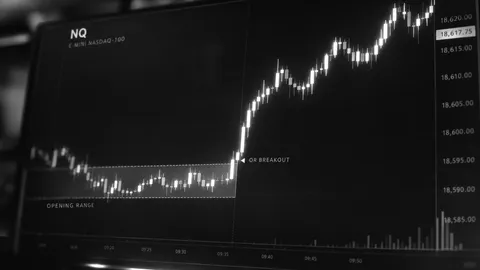
People ask which one is better to trade. It depends on which market you want to learn, because they're different markets with different charts. I teach one market, Nasdaq futures, so everything in the course is built on that chart. The setups, like the opening range breakout, are the same on NQ and MNQ.
Sources
- 01CME Group, Micro E-mini Nasdaq-100 (MNQ) contract specscmegroup.com
- 02CME Group, E-mini Nasdaq-100 (NQ) contract specscmegroup.com
- 03CME Group, Micro E-mini S&P 500 (MES) contract specscmegroup.com
- 04CME Group, MNQ margins (checked September 24, 2026)cmegroup.com
- 05CME Group, NQ margins (checked September 24, 2026)cmegroup.com
- 06CME Group, contract month codescmegroup.com
Margins and fees change. Check with your broker before you trade.
10 years of videos, free to watch.
News, trading and following the money. Free on YouTube.
- No sign-up
- A video a day
- Three channels