How Much Money Do You Need to Trade MNQ?
Exchange margin, broker margin, the old $25,000 rule, what a losing trade costs, and why paper comes first.

I get asked this one all the time. People mix up three different numbers, and only one of them is up to you.
Three numbers people mix up
The exchange's margin
Margin is money your broker holds while you have a trade open. It's a deposit against losses, not the price of the contract. CME Group, the exchange where MNQ trades, sets a minimum for positions held overnight. On September 24, 2026, CME's maintenance margin for one December 2026 MNQ contract was $4,320 for a long position and $4,127 for a short one.
Your broker's day-trade margin
Brokers set their own margin for trades you open and close in the same session. It can be lower than CME's overnight figure, it varies from broker to broker, and it can change. Check your broker's margin page on the day you plan to trade.
The money you can afford to lose
This is the number that matters most, and nobody can set it for you. The SEC's guide on day trading says it plainly: day traders "should only risk money they can afford to lose." The same guide says never to use money you need for daily living expenses or retirement. That rules out rent, groceries and your emergency fund.
Futures add one more reason to take this seriously. The CFTC, which oversees the futures markets, warns that many people lose all of their money and can be required to pay more than they put in.
Do you need $25,000 to day trade futures?
No. The $25,000 figure came from FINRA's pattern day trader rule. It set a $25,000 minimum for people who day traded often in a margin account at a stock brokerage, and it was part of FINRA Rule 4210, the margin rule for securities accounts. Futures accounts are overseen by a different regulator, the Commodity Futures Trading Commission (CFTC), so that minimum never applied to futures like MNQ.
The rule is on its way out for stocks, too. In Regulatory Notice 26-10, FINRA replaced the old day trading margin requirements, including the pattern day trader label and the $25,000 minimum, with new intraday margin standards. The change took effect on June 4, 2026, and firms that need more time have until October 20, 2027 to phase it in.
What a losing trade costs on MNQ
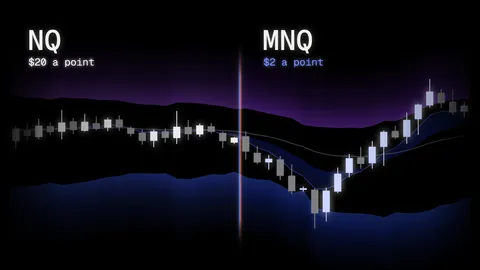
MNQ moves $2 for every point of the Nasdaq-100 futures price. So a loss is the points you lost times $2, plus fees.
One of my rules is right in a lesson title: "Only Lose One Bar." A bar is one candle on your chart. The idea is to keep a losing trade small and short, and not sit in it hoping it comes back.
Can you trade MNQ with $100?
Do the arithmetic. One MNQ contract can't be held overnight on $100, because CME's minimum on September 24, 2026 was $4,320. For trades inside the day it depends on your broker's day-trade margin. Even if an account lets you open one contract, five losing trades of 10 points each would take the whole $100 before fees.
$100 is enough to learn on paper. It isn't enough to trade real money with, because five losing trades like the ones above would end the account.
Is $1,000 enough to trade futures?
The same arithmetic applies. $1,000 is less than a quarter of CME's overnight margin for one MNQ contract ($4,320 on September 24, 2026), so it can't hold one overnight either. Inside the day, it depends on your broker. At $20 a loss (10 points on one MNQ), $1,000 covers fifty losing trades before fees. That's more room to learn than $100 gives you, and it still has to be money you can lose without it touching your bills.
Paper first
A paper trading account lets you practice on the real chart with pretend money. It's where the habits get built. Before you use real money, you want to be able to do these on paper, every time:
- Find the setups you've learned without guessing.
- Set your stop before you enter.
- Take the loss at your stop without moving it.
- Stop for the day when your plan says stop.
- Write down every trade, the wins and the losses.
If those don't hold up on paper, real money won't make them easier. When you do trade real money, only use money you can afford to lose.
The course covers this in lessons like "Paper Trading & Leverage," "Stop Loss" and "Never Chase a Loss." If you're still choosing a contract, start with MNQ vs NQ. For the bigger picture on losses, read why most day traders lose money. And if you want the whole routine, step by step, here's what's inside the course.
Sources
- 01CME Group, MNQ margins (checked September 24, 2026)cmegroup.com
- 02CME Group, Micro E-mini Nasdaq-100 (MNQ) contract specscmegroup.com
- 03FINRA, Regulatory Notice 26-10: new intraday margin standards replace the day trading margin requirementsfinra.org
- 04SEC, Day Trading: Your Dollars at Risksec.gov
- 05CFTC, Basics of Futures Tradingcftc.gov
Margins and fees change. Check with your broker before you trade.
10 years of videos, free to watch.
News, trading and following the money. Free on YouTube.
- No sign-up
- A video a day
- Three channels